Moana Surfrider · Waikīkī
He named his club on this lawn
Hui Nalu, the Club of the Waves, around 1908. Duke Kahanamoku, Knute Cottrell and Kenneth Winter sat under a hau tree by the hotel bathhouse and gave it a name. The bathhouse was the clubroom. Dues were a dollar a year and bought you a clothes hook.
What this is
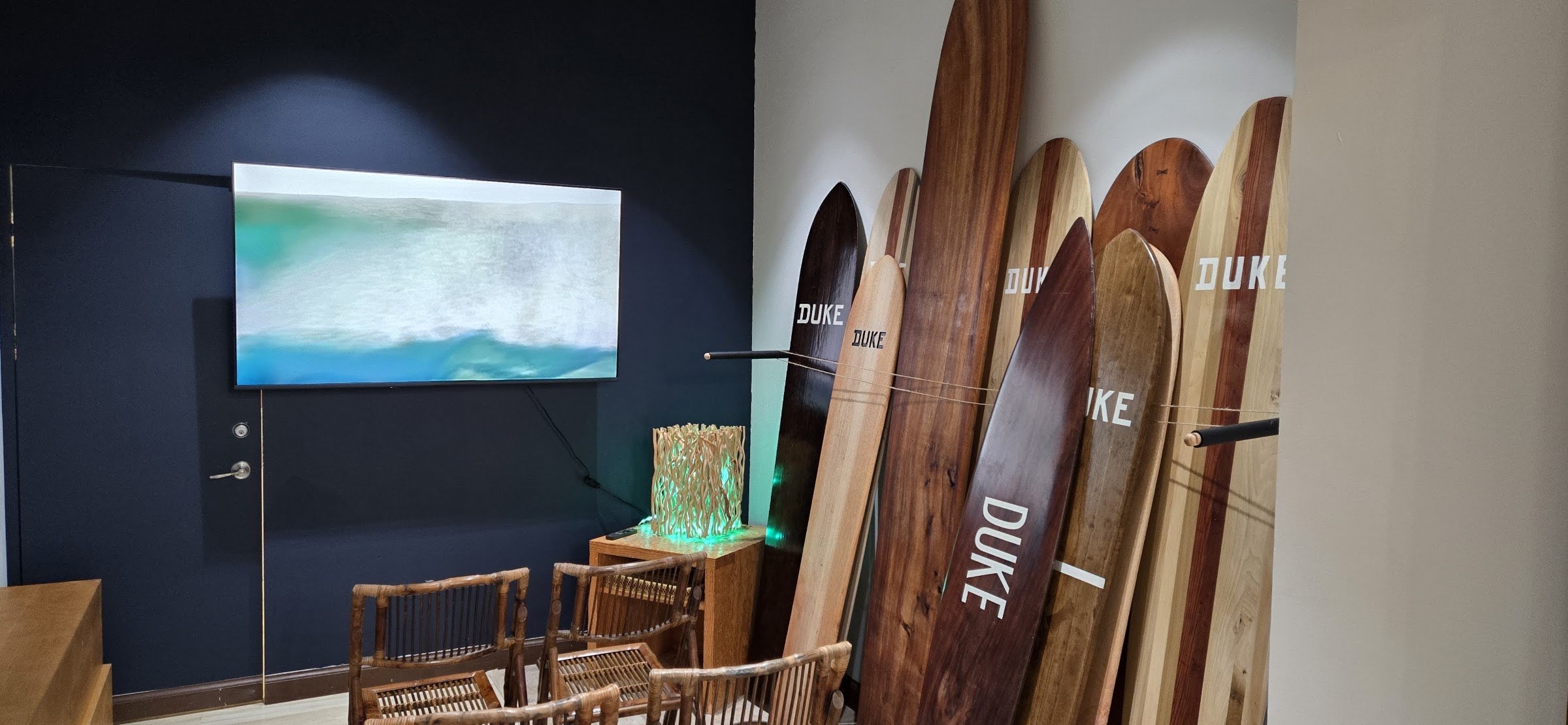
A gallery. Photographs from Duke’s life down the long wall, boards standing in the window bays, and a film with chairs in front of it. The gallery is authorized to carry his name.
What is in it
An exhibition that changes through the year, a condensed cut of Waterman in the alcove at about ten minutes, and goods carrying his name. Those are the gallery’s own and the label says so. Nothing here is presented as somebody else’s handiwork.
Where it is
Inside the Moana Surfrider, 2365 Kalākaua Avenue. The bronze of Duke on Kūhiō Beach is a few hundred steps down the street. Kalia, where he grew up, is at the far end of the same beach.
The short version
Who he was
Duke Paoa Kahinu Mokoe Hulikohola Kahanamoku was born on 24 August 1890, in the Kingdom of Hawaiʻi. The Kingdom was overthrown in January 1893, when he was two. His family moved that same year to Kalia, at the far end of this beach, to be near his mother’s people, the Paoas.
His grandfather Hoʻolae Paoa had claimed the Kalia land as a kuleana in the Māhele of 1848 and received it. About eight thousand Hawaiians received kuleana awards, on under one percent of the land. The Hilton Hawaiian Village stands on the Paoa ground now. We have not established how it left the family, and we would like to know.
He was named for his father, who was christened Duke by Bernice Pauahi Bishop in honor of Prince Alfred, Duke of Edinburgh, who was visiting Hawaiʻi. It is a given name, not a title.
In August 1911, in Honolulu Harbor, he swam a hundred yards in 55.4 seconds, 4.6 seconds inside the world record. The course had been measured four times, once by a professional surveyor, and five certified judges timed it. The Amateur Athletic Union refused to ratify the swim and suggested the judges had used alarm clocks rather than stopwatches. He broke the record again the following year, on the mainland, under their supervision.
He won five Olympic medals, three gold and two silver, at Stockholm in 1912, Antwerp in 1920 and Paris in 1924. Hui Nalu paid his way to the first trials by subscription and donation. He swam for the United States, which had annexed Hawaiʻi in 1898.
Surfing is heʻe nalu. It is Native Hawaiian and centuries older than him, and he did not invent it. What he did was take it with him. On Christmas Eve 1914, at Freshwater in Sydney, he shaped a board from local sugar pine and paddled out. Australia dates its surfing to that afternoon, and the board is still at the club there. He carried it from Waikīkī to the world.
On 14 June 1925, off Newport Beach in California, a fishing boat called the Thelma capsized. He went out on his board and brought eight men in alive. Three other men brought in four more.
Elected Sheriff of the City and County of Honolulu in 1934, he served thirteen consecutive terms until the office was abolished in 1961. He died on 22 January 1968. Jan Gordon Fisher’s nine-foot bronze of him was dedicated at Kūhiō Beach on 24 August 1990, his hundredth birthday, a few hundred steps from this door.
That is the short version. alohatoyou.com is the long one: the whole life, the creed in his own words, the film, and the foundation that carries his name.
Inside
What is in the room
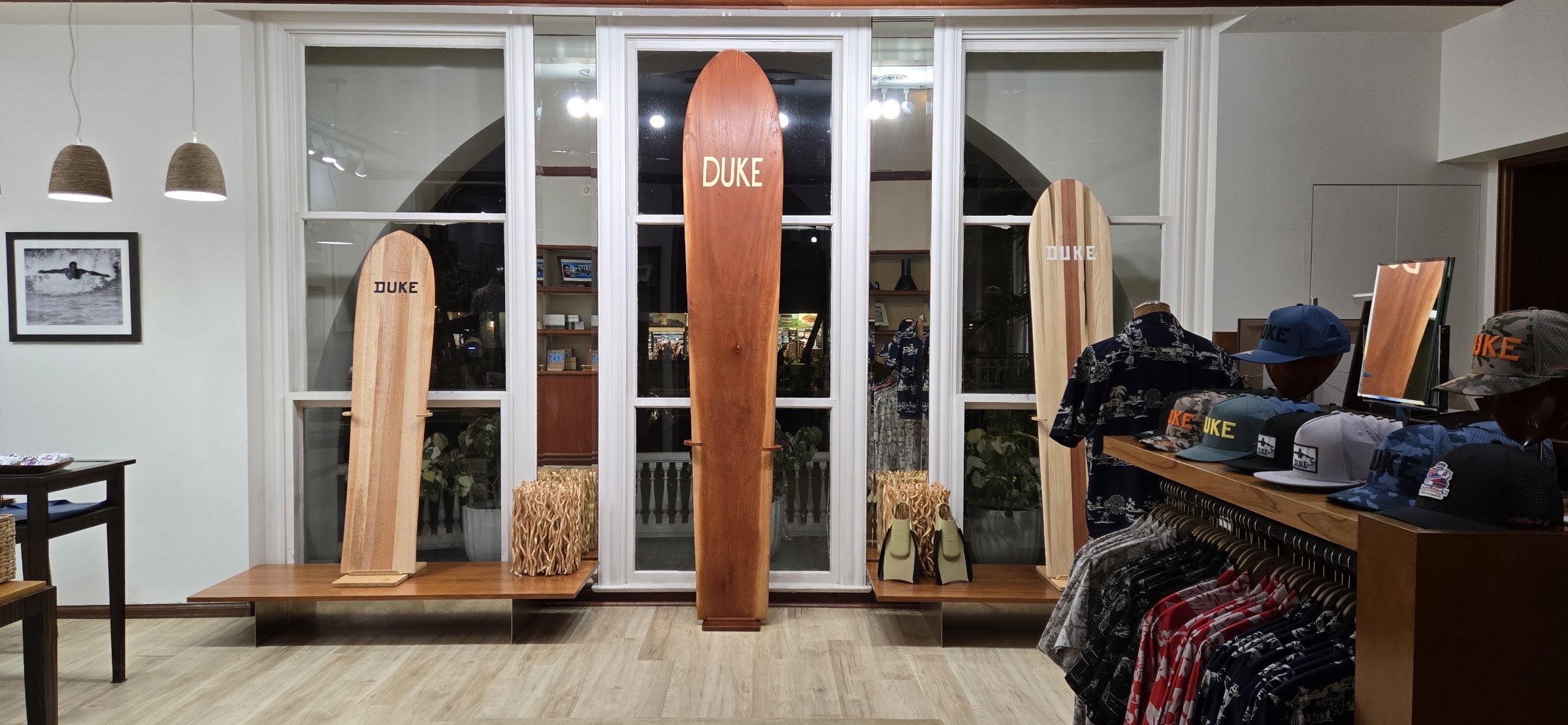
Everything in here that carries Duke’s name is the gallery’s own, and its label says so. There is no named maker attached to any of it, and we do not dress it up as though there were.
What is not for sale is the part worth coming for. The photographs down the long wall, the boards standing in the window bays, and the film.
His signature goes on an object once, small, usually somewhere you would not think to look for it.
Sit for the film
A condensed cut of Waterman, the documentary about Duke’s life, runs in the alcove. It is about ten minutes. There are chairs. You do not have to buy anything.
Visit
Where and when
Come in. You do not have to buy anything.
The gallery is open. We have not published the hours here yet, so ask at the hotel desk before you make a trip for it.
The gallery is a pop-up at the Moana Surfrider, about 6 months, not a permanent room. The run dates are not published here yet.